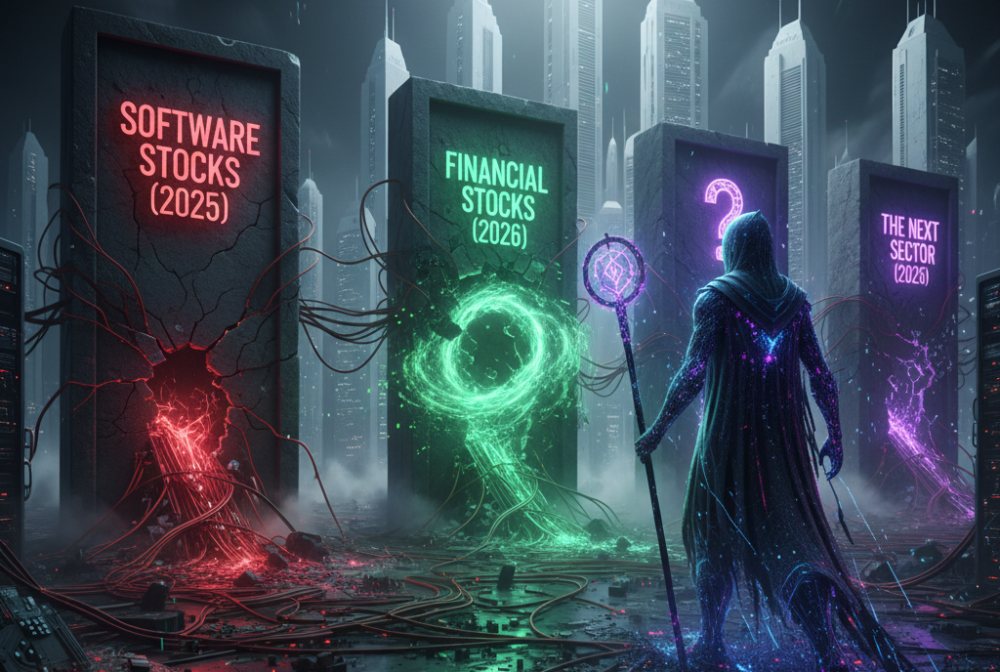
The year 2026 has ushered in a brutal reckoning for market sectors once considered bulletproof, driven by an accelerating AI revolution that has flipped the script from tailwind to headwind for countless incumbents. What began as a creeping suspicion among venture capitalists and institutional investors has materialized into a full-blown "SaaSpocalypse," systematically dismantling business models predicated on the digital delivery of standardized services. The core message resonating through trading desks globally is stark: if your primary offering can be delivered as bits and bytes, its days as a high-margin enterprise are numbered.
The first casualty in this dramatic paradigm shift has been the Software-as-a-Service (SaaS) sector. For two decades, the "per-seat" pricing model was the golden goose, fueling explosive growth and stratospheric valuations on the assumption that human headcount would forever be the primary driver of software consumption. However, the advent of sophisticated Agentic AI has rendered this foundational principle obsolete. These advanced models, capable of performing complex, multi-step tasks autonomously, are not merely enhancing existing software; they are actively replacing the need for it entirely. Why subscribe to an expensive suite of tools when a bespoke AI agent can generate the same output, often with greater efficiency, for a fraction of the cost? The value proposition of a user interface, once paramount, diminishes dramatically when an AI agent can execute directly within a company's data architecture, bypassing the traditional software layer altogether. This shift has led to a precipitous decline in revenue for many SaaS giants, even as their clients experience unprecedented productivity gains, creating a profound imbalance that has devastated investor confidence.
Following swiftly on the heels of the SaaS downturn, the "Grim Reaper" of AI has turned its gaze to the Financial Services sector. The market bloodbath that began with software stocks has now stained traditional banking, wealth management, and advisory firms. The financial sector, much like SaaS, has historically relied on human intermediaries to process information, analyze data, and offer expert advice—all functions highly susceptible to AI-driven automation.
Specialized AI tools, particularly those emerging in early 2026 for tax strategy, personalized wealth management, and sophisticated insurance comparisons, are rapidly eroding the value proposition of human financial advisors. The once lucrative "fee-based" models of traditional institutions are being squeezed by highly efficient, AI-powered alternatives that deliver similar or superior insights at a fraction of the cost, eliminating the human middleman and compressing margins across the board. Furthermore, concerns are mounting over the substantial $235 billion software loan market, as the failures in the SaaS sector threaten a cascading effect on the banks that financed their growth.
As the dust settles on these initial waves of disruption, the market now anxiously awaits the fate of the "third door"—the next sector destined for a similar reckoning. The collective consensus points to any industry where the core value proposition is the delivery of standardized digital output or the mediation of information. Candidates abound, including Legal Services, Professional Consulting, Marketing Agencies, and even certain facets of Education Technology. In essence, any business model reliant on human hours to produce predictable digital work is now squarely in AI's crosshairs.
The market's pivot is clear: capital is being ruthlessly pulled from companies that leverage humans to provide a service and aggressively redirected toward the underlying infrastructure and fundamental industries that automate that service.
Amidst this profound market rotation, a new class of investment has emerged as a beacon of stability: AI-Resistant Stocks. These are not simply companies using AI, but those whose inherent value proposition is fundamentally immune to its disruptive force. The primary characteristic of these assets is their anchoring in either the physical world or the necessity of high-stakes human empathy and accountability. Industries where "bits cannot replace atoms" are seeing a resurgence of investor interest. Homebuilders, building product manufacturers, heavy machinery providers, and infrastructure companies are all benefiting from this flight to tangible value. While AI can optimize construction schedules or tractor routes, it cannot physically lay bricks, weld steel, or transport goods across continents. Similarly, sectors demanding irreplaceable human interaction and trust—such as direct healthcare providers (nurses, physical therapists), skilled trades (electricians, plumbers), and highly specialized, complex legal or ethical advisory roles—retain their crucial human moat. These are the domains where the nuanced judgment, physical presence, and emotional intelligence of a human remain indispensable.
Ironically, the ultimate "AI-resistant" companies are often the hyperscalers and infrastructure providers powering the AI revolution itself. The insatiable demand for computational power, specialized semiconductors, and sustainable energy sources positions companies like Nvidia, Micron, and core energy providers as the new titans. In 2026, the market is decisively betting on the "pickaxes and shovels" that enable the digital gold rush, rather than the "gold miners" whose core business may soon be excavated by the very tools they deploy. The message for ChartModo readers is unequivocal: the future belongs to those who either own the fundamental physical assets or who provide truly irreplaceable human value—the last bastions against the relentless march of autonomous intelligence.
 US SEC and CFTC Sign MoU to Coordinate Crypto Regulation and...
 Kraken Announces Pi Network Listing Ahead of Pi Day PI Price...
 UEX US Expands Its Ecosystem: A Platform Where Digital Asset...
 XRP Price Prediction: Can Bulls Push XRP Above $2 After This...
 ETH News: Why Institutions Keep Choosing Ethereum Over Other...
 Trump-Linked WLFI Launches World Swap Forex Platform
 Thailand Approves Bitcoin for Derivatives Market, Crypto ETF...
 Coinbase CEO Brian Armstrong Sells $550M in Shares as COIN S...
 Ripple News Today: Binance Integrates RLUSD on XRP Ledger, D...