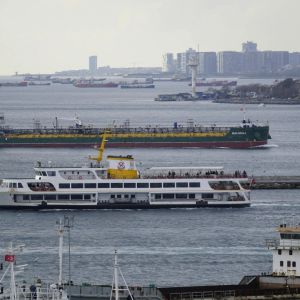
Iran is putting a price on passage through the Strait of Hormuz, with a new toll system that starts oil tankers at about $1 per barrel and asks for payment in yuan or stablecoins. The first step came when Iran’s National Security Committee approved a bill to charge ships using the route, Fars reported, citing a committee member. From there, a much fuller system began to come into view, with shipping paperwork, military checks, payment talks, radio codes, and naval escorts all built into the process. Several people with direct knowledge of the arrangement said ship operators must begin by dealing with an intermediary company tied to the IRGC. That company collects the vessel’s ownership details, flag, cargo manifest, destination, crew list, and AIS data. After that, the file is sent to the IRGC Navy’s Hormozgan Provincial Command, where the vessel is screened for any connection to Israel, the US, or other countries that Iran classifies as hostile. Iran screens ships before letting them enter Hormuz If a ship passes the check, the fee talks begin. People familiar with the arrangement said Iran uses a ranking system that scores countries from one to five. States seen as friendlier are more likely to get better terms. For oil tankers, the opening number in those talks is usually around $1 per barrel of oil. The money is not meant to be paid in dollars. The starting terms call for settlement in Chinese yuan or stablecoins. The process does not stop at payment. Once the toll is agreed and paid, the IRGC gives the vessel a permit code and a specific route to follow. The ship must then sail under the flag of the country that secured the transit deal. In some cases, the vessel may also have to change its official registration to that country. As it nears the Strait of Hormuz, the ship is expected to broadcast its passcode over very high frequency radio. A patrol boat then meets it and escorts it through the waterway, staying close to the coast and passing between islands along the route. A recent case involving Pakistan shows how this is working on the ground. Iran agreed to let 20 Pakistani vessels pass through the strait. The problem was that Pakistan had only a small number of flagged ships in the Gulf. That pushed Islamabad to approach some of the world’s biggest commodity traders and ask whether they had vessels that could pass through Hormuz while temporarily sailing under a Pakistani flag. The geography matters too. Countries usually control 12 nautical miles from their coastlines, which is about 14 miles or 22 kilometers. Inside that zone, they are generally allowed to inspect vessels. That gives legal and operational weight to a system built around coastal passage, flag rules, patrol escorts, and controlled routing. Iran and Oman draft new transit rules as markets react At the same time, Iran and Oman are working on a joint protocol to “monitor transit” through the Strait of Hormuz, IRNA reported on Thursday morning, citing an official. Kazem Gharibabadi, Iran’s deputy foreign minister for legal and international affairs, said tanker traffic through the route “should be supervised and coordinated” with the two countries. Kazem also said:- “Of course, these requirements will not mean restrictions, but rather to facilitate and ensure safe passage and provide better services to ships that pass through this route.” That update hit the market fast. US stock indexes had been falling sharply on Thursday morning after President Donald Trump signaled that the Iran war could continue for weeks. After the IRNA report about the talks with Oman, those indexes turned higher. Oil also reacted. Prices had jumped overnight, then pulled back from the day’s highs after the Oman news raised hope that the Strait of Hormuz might reopen in some form without military action. Still, the oil market remained under heavy pressure. S&P Global said the spot price for physical Brent crude cargoes jumped to $141.36 on Thursday, the highest level since the 2008 financial crisis. That spot price covers Brent deliveries scheduled for the next 10 to 30 days. The sharp rise in those near-term barrels shows how tight physical supply has become after the disruption caused by Iran’s closure of the Strait of Hormuz. If you want a calmer entry point into DeFi crypto without the usual hype, start with this free video.
 US SEC and CFTC Sign MoU to Coordinate Crypto Regulation and...
 Kraken Announces Pi Network Listing Ahead of Pi Day PI Price...
 UEX US Expands Its Ecosystem: A Platform Where Digital Asset...
 XRP Price Prediction: Can Bulls Push XRP Above $2 After This...
 ETH News: Why Institutions Keep Choosing Ethereum Over Other...
 Trump-Linked WLFI Launches World Swap Forex Platform
 Thailand Approves Bitcoin for Derivatives Market, Crypto ETF...
 Coinbase CEO Brian Armstrong Sells $550M in Shares as COIN S...